
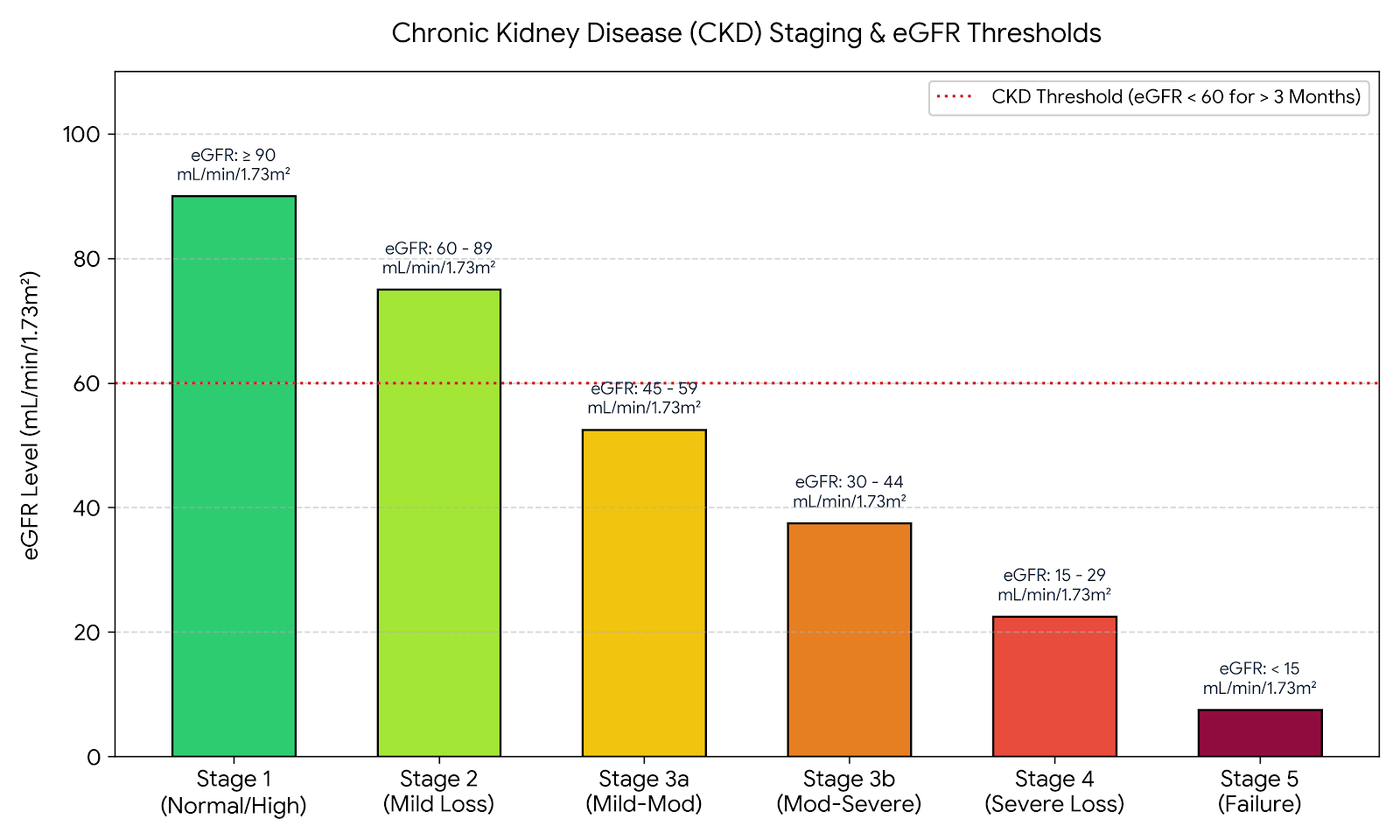
What Do GFR Units Actually Mean? Breaking Down the Math
When you open your metabolic panel or renal lab report, you’ll usually spot a number listed next to your Estimated Glomerular Filtration Rate (eGFR) followed by a mouthful of a unit: $\text{mL/min/1.73m}^2$.
If that looks more like a high school physics equation than a simple health score, you aren't alone. Let’s break down what each piece of that mathematical unit is actually measuring under the hood:
[ mL / min / 1.73m² ]
  |     |      |
  |     |      +---> Scaled to Standard Body Surface Area (1.73 square meters)
  |     +---------> Time Interval (per minute)
  +---------------> Liquid Volume Filtered (milliliters of blood plasma)
-
Milliliters ($\text{mL}$): The physical volume of blood plasma cleared of waste products (like creatinine or cystatin C) by the microscopic capillary loops in your kidneys, known as glomeruli.
-
Per Minute ($\text{min}^{-1}$): The rate at which this filtration takes place over time.
-
Per $1.73\text{ m}^2$ ($\text{1.73m}^{-2}$): A standardization factor representing the average human Body Surface Area (BSA), originally derived from historical physiological population surveys.
In simple terms: if your eGFR is $90\text{ mL/min/1.73m}^2$, your kidneys are clearing about 90 milliliters of blood plasma every 60 seconds for every $1.73\text{ square meters}$ of body surface area. To put that volume into perspective, a healthy pair of kidneys filters roughly 180 liters (nearly 48 gallons) of fluid every single day!
If you are trying to contextualize where your numbers sit across the diagnostic spectrum, check out our guide on understanding when to worry about eGFR levels.
Why Is Body Surface Area ($1.73\text{ m}^2$) Included in the Unit?
You might wonder why scientists don't just use simple flow rates like "liters per hour" or "gallons per day." The answer comes down to a fundamental physiological reality: kidney size scales with overall body size.
A 6-foot-4 tall basketball player naturally has larger kidneys with more total nephrons than a 5-foot-0 petite adult. If researchers measured raw, uncorrected fluid flow, the basketball player would almost always appear to have "better" kidney function simply because they have larger organs filtering a bigger blood volume.
+-----------------------------------------------------------------------------------+
|                  THE BODY SURFACE AREA (BSA) EQUALIZER                            |
+-----------------------------------------------------------------------------------+
| Larger Body / Taller Height  ---> Larger Kidneys ---> Higher Raw Flow Rate        |
| Smaller Body / Shorter Height ---> Smaller Kidneys ---> Lower Raw Flow Rate         |
|                                                                                   |
| SOLUTION: Divide raw flow rate by patient's BSA and multiply by 1.73 m²          |
| RESULT: An apples-to-apples comparison across all body types & clinical studies   |
+-----------------------------------------------------------------------------------+
Back in 1928, physiological researchers Homer Smith and McIntosh evaluated population body measurements and established $1.73\text{ m}^2$ as the mean body surface area of a young American adult. By adjusting everyone's raw filtration rate to this standardized surface area baseline, nephrologists created an "apples-to-apples" metric that allows researchers to compare kidney health consistently across global populations, clinical trials, and epidemiological datasets.
For a broader look at baseline diagnostic metrics and alarming lab thresholds, explore our breakdown on what level of creatinine is alarming.
How Researchers Estimate GFR: The Evolution of Scientific Equations
Measuring direct, true GFR is actually quite invasive. In academic clinical trials, researchers infuse a patient with an exogenous sugar tracer called inulin (or radioactive isotopes like $^{125}\text{I-iothalamate}$) and continuously measure how fast the kidneys clear it from the blood into urine over several hours.
Because direct clearance studies are time-consuming and expensive, clinical medicine relies on estimation equations (eGFR) using endogenously produced biomarkers like creatinine (a breakdown product of muscle tissue) and cystatin C (a protein produced by all nucleated cells).
[ Direct Inulin Clearance (Gold Standard) ]  <--- Highly Invasive / Research Settings
                   VS.
[ eGFR Serum Equations (CKD-EPI 2021) ]      <--- Fast, Low-Cost Clinical Testing
Over the decades, the mathematical models used to convert serum biomarkers into $\text{mL/min/1.73m}^2$ have evolved significantly based on emerging clinical research data:
| Equation Name | Year Introduced | Primary Biomarkers Used | Key Research Modifications & Notes |
| Cockcroft-Gault | 1973 | Serum Creatinine, Age, Weight | Estimates Creatinine Clearance in $\text{mL/min}$ (unindexed); overestimates true GFR due to tubular secretion. |
| MDRD Study | 1999 | Serum Creatinine, Age, Sex, Race | Developed from the Modification of Diet in Renal Disease trial; underestimated GFR in healthy individuals ($>60$). |
| CKD-EPI (Original) | 2009 | Serum Creatinine, Age, Sex, Race | Improved precision at higher GFR levels; reduced false-positive CKD diagnoses in healthy cohorts. |
| CKD-EPI 2021 | 2021 | Creatinine and/or Cystatin C, Age, Sex | Current Gold Standard: Removed race variables to eliminate diagnostic bias; endorsed by NKF and ASN. |
The transition to the CKD-EPI 2021 equation marked a major research milestone. Clinical studies led by the National Kidney Foundation (NKF) and the American Society of Nephrology (ASN) demonstrated that removing racial coefficient adjustments provided standardized, unbiased filtration estimates without sacrificing clinical diagnostic precision.
If you are exploring how underlying filtration changes affect long-term management strategies, review our article on whether stage 4 CKD can be cured.
Absolute GFR vs. Relative GFR: The Pharmacy Perspective
Understanding GFR units requires distinguishing between Relative eGFR (indexed to $1.73\text{ m}^2$) and Absolute GFR (unindexed raw flow in $\text{mL/min}$). While this distinction sounds like technical hair-splitting, it carries massive clinical implications when it comes to medication dosing and pharmacology.
+-----------------------------------------------------------------------------------+
|                        RELATIVE vs. ABSOLUTE GFR COMPARISON                       |
+-----------------------------------------------------------------------------------+
| * Relative (Indexed) eGFR: Expressed in mL/min/1.73m²                             |
|   -> Purpose: Staging Chronic Kidney Disease (CKD Stages 1 through 5)            |
|   -> Normalizes function across general populations                               |
|                                                                                   |
| * Absolute (Unindexed) GFR: Expressed in mL/min                                   |
|   -> Formula: Absolute GFR = Relative eGFR x (Patient's Individual BSA / 1.73 m²)  |
|   -> Purpose: Adjusting medication dosages (chemotherapy, antibiotics, NOACs)   |
+-----------------------------------------------------------------------------------+
When clinical pharmacists determine the correct dose for medications excreted by the kidneys (such as SGLT2 inhibitors, blood thinners, or specific antibiotics), using indexed GFR can lead to under- or over-dosing in patients who are significantly larger or smaller than $1.73\text{ m}^2$.
For example, an exceptionally large individual ($2.5\text{ m}^2\text{ BSA}$) might have an indexed eGFR of $45\text{ mL/min/1.73m}^2$, suggesting moderate renal impairment. However, their absolute filtration rate is actually:
Because their body clears drugs at $65\text{ mL/min}$, calculating drug clearance based solely on the indexed lab value could lead a clinician to under-prescribe necessary medications. Conversely, for petite patients, unindexing prevents accidental drug toxicity.
For details on how medical teams manage prescription selection across different filtration tiers, read our overview on what medication is used for stage 3 kidney disease.
What Factors Can Distort Your GFR Unit Interpretation?
While the unit $\text{mL/min/1.73m}^2$ is standardized, the underlying laboratory biomarkers used to calculate it can be influenced by non-renal physiological variables. Understanding these research-backed confounding factors helps prevent unnecessary health anxiety when reviewing lab trends.
[ High Muscle Mass / Heavy Meat Diet ] ---> [ Elevated Serum Creatinine ] ---> [ Artificially LOWER eGFR ]
[ Low Muscle Mass / Amputation ]        ---> [ Reduced Serum Creatinine ]  ---> [ Artificially HIGHER eGFR ]
1. Muscle Mass and Serum Creatinine
Creatinine is generated at a steady rate by skeletal muscle breakdown. Consequently, individuals with exceptional muscle mass (such as bodybuilders or powerlifters) often show elevated serum creatinine levels, yielding an artificially lower eGFR reading despite having completely healthy kidneys. Conversely, elderly patients or individuals with muscle wasting (sarcopenia) may have artificially elevated eGFR scores.
2. Dietary Protein Spikes
Consuming large quantities of cooked red meat shortly before a blood draw can temporarily spike serum creatinine levels by up to 20–30%, resulting in a transient, artificial drop in calculated eGFR units.
3. Acute Hydration Volatility
Glomerular filtration depends directly on intravascular fluid volume and blood pressure. Severe dehydration reduces renal perfusion, temporarily pulling down your eGFR units. To explore evidence-based hydration and dietary protocols that support baseline clearance, check out our guide on how to cleanse your kidneys naturally and avoid dialysis.
4. Back Pain vs. Kidney Discomfort
Patients often confuse musculoskeletal back pain with kidney-related flank discomfort during periods of fluctuating lab results. For physical diagnostic markers, read our clinical guide on what back pain from kidney disease feels like.
| Confounding Variable | Impact on Serum Creatinine | Impact on Calculated eGFR (mL/min/1.73m2) | Recommended Clinical Action |
| High Muscle Mass | Elevated | Artificially Decreased | Confirm filtration using a Serum Cystatin C panel. |
| Cooked Meat Intake | Transiently Elevated | Artificially Decreased | Fast from heavy meat meals 12–24 hours prior to blood draw. |
| Dehydration | Mildly Elevated | Temporarily Decreased | Rehydrate adequately and re-test basic metabolic panel. |
| Amputation / Muscle Wasting | Decreased | Artificially Increased | Utilize 24-hour urine creatinine clearance or Cystatin C. |
When to Consult Your Renal Healthcare Team
Interpreting trends in your eGFR units over time is far more clinically meaningful than obsessing over a single isolated blood test.
[ Baseline eGFR Test ] ---> [ Track Multi-Month Trend ] ---> [ Identify Sustained Shifts ] ---> [ Nephrology Consultation ]
Consult your physician or nephrologist if you notice any of the following research-backed warning signals:
-
Sustained Decline in eGFR: A continuous drop of more than $5\text{ mL/min/1.73m}^2$ within a single year, or a drop greater than 30% from your established baseline.
-
Discordance Between Creatinine and Cystatin C: If your creatinine-based eGFR and cystatin C-based eGFR yield widely divergent results.
-
Persistent Proteinuria / Albuminuria: Protein leaking into the urine alongside fluctuating eGFR numbers indicates active glomerular inflammation. For dietary guidelines on mitigating structural strain, see our resource on foods to avoid with kidney disease.
Frequently Asked Questions
Can my eGFR units go back up after dropping?
Yes! Calculated eGFR units fluctuate regularly based on hydration status, recent dietary protein intake, medication changes, and blood pressure control. An acute drop caused by temporary factors like dehydration or medication interaction (such as NSAID use) can be restored once the underlying trigger is addressed. However, chronic structural nephron loss from long-term scarring is generally irreversible, making stabilization the primary goal.
Why is Cystatin C considered a more reliable biomarker than Creatinine for GFR units?
Cystatin C is a small protein produced at a constant rate by all nucleated cells in the body. Unlike creatinine, its circulating levels are virtually unaffected by muscle mass, age, sex, or dietary protein intake. As a result, cystatin C-based eGFR equations ($\text{eGFR}_{\text{cys}}$) provide a far more accurate assessment of filtration for elderly individuals, bodybuilders, or people with chronic illness.
What is considered a "normal" eGFR unit score for my age?
While a baseline eGFR of $90\text{ mL/min/1.73m}^2$ or higher is generally classified as normal for young adults, GFR naturally declines by approximately $0.75\text{ to }1\text{ mL/min/1.73m}^2$ per year after age 40 as part of normal physiological aging. Consequently, an eGFR reading of $65–75\text{ mL/min/1.73m}^2$ may be completely expected for a 75-year-old individual without underlying renal pathology.
Do children use the same GFR unit formulas as adults?
Children use the same unit of measurement ($\text{mL/min/1.73m}^2$), but their eGFR is calculated using pediatric-specific formulas—such as the Bedside Schwartz equation—which incorporate serum creatinine and the child's height (length) in centimeters to account for rapid growth and developmental changes.
Are you tired of living under the shadow of kidney disease? Are you yearning for a life free from the shackles of dialysis, kidney failure, and the looming threat of kidney transplants? If so, you're in the right place at the right time. Imagine waking up every morning with boundless energy, feeling rejuvenated and ready to take on the day. Envision a life where your kidneys are functioning optimally, and you no longer dread the burdensome routines of dialysis sessions. The Kidney Disease Solution Program is here to turn that vision into reality for you.